

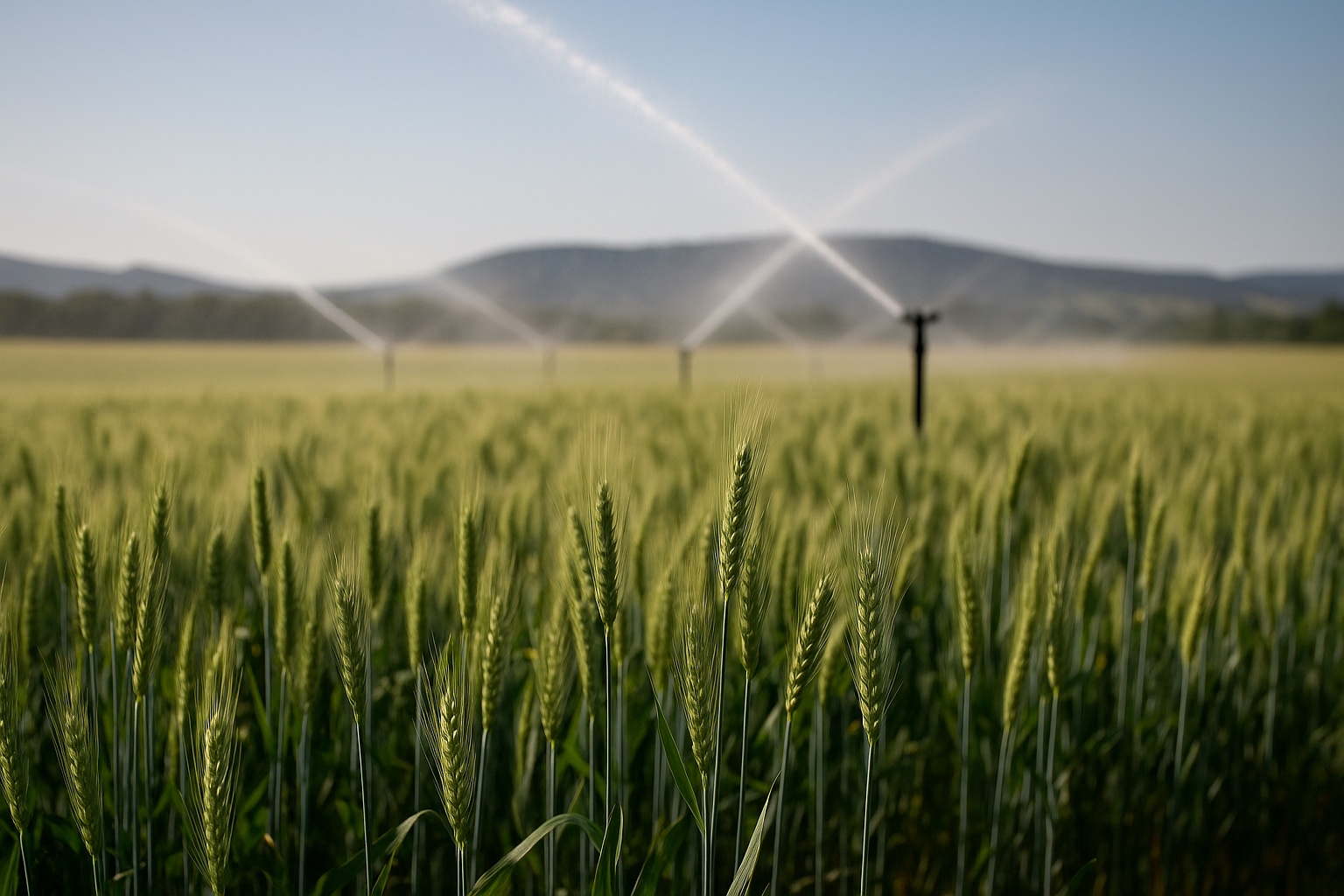
A new study dedicated to the resilience of durum wheat under Mediterranean climate conditions has been published in Agricultural Water Management, titled “Integrating deficit irrigation, crop modelling and Water–Energy–Food nexus to enhance durum wheat resilience in Mediterranean climate conditions”.
The research team includes, for CRS4, researchers Marino Marrocu, Luca Massidda, Simone Manca, and Gabriella Pusceddu from the Visual and Data-Intensive Computing sector, together with Marco Dettori, Giulia Urracci, and Gianluca Carboni from AGRIS, and Valentina Mereu from CMCC.
The study was carried out within the European project ARSINOE, funded by the Horizon 2020 programme, and the institutional project XDATA supported by the Regional Government of Sardinia.
The work examines the effect of three water regimes, full, deficit, and rainfed, applied to durum wheat grown at two experimental sites in Southern Sardinia over two markedly different agricultural seasons. The findings show that deficit irrigation, applied at 50% of the crop water requirement, can achieve yields and quality comparable to full irrigation, while significantly reducing water consumption and, in some cases, proving even more energy-efficient.
CRS4’s contribution was particularly significant in the simulation and modelling component: through the advanced use of AquaCrop, the FAO-developed model designed to simulate crop growth based on water availability and calibrated on field data, researchers were able to reconstruct soil moisture dynamics and crop water status. This was achieved by integrating agronomic observations with information from Sentinel-2, the European satellite constellation providing high-resolution multispectral imagery for vegetation monitoring, and real-time meteorological data.
This analysis was framed within the Water–Energy–Food Nexus, an approach that examines the interconnections between water use, energy consumption, and food production, enabling a comprehensive evaluation of yield, water use, energy impacts, and economic efficiency across different irrigation strategies.
Overall, the results demonstrate that, in Mediterranean environments characterized by increasing water scarcity and strong climatic variability, moderate irrigation strategies supported by predictive models can offer an effective way to maintain stable durum wheat production while reducing resource use and improving the sustainability of agricultural systems.
For further details on the methods, results, and implications of the study, the full article is available at the following link: ScienceDirect – Agricultural Water Management.