
A review by CRS4 researchers analyses and compares deterministic approaches for linking the mechanisms that regulate the cell cycle to cell population dynamics.
How can we move from the mechanisms that regulate the cell cycle of a single cell to a mathematical description of the behaviour of an entire cell population?
This is the focus of Cell Population Dynamics Informed by Cell-Cycle Regulation: A Deterministic Modeling Toolkit, a review published in the Computational and Structural Biotechnology Journal and authored by CRS4 researchers Elsi Ferro, Antonio Laus, Rossano Atzeni, Maria Valentini, Enrico Pieroni and Massimo Pisu.
Cell populations grow, decline and change in composition depending on what happens to individual cells, which may divide, stop proliferating or die. The cell cycle therefore provides a fundamental link between the regulatory mechanisms acting within individual cells and the dynamics observed at the level of the entire population.
The study presents a theoretical and methodological toolkit, understood as a set of tools and approaches for modelling cell populations. The different deterministic models are analysed along two main dimensions: the level at which heterogeneity among cells within a population is represented, and the degree of detail with which cell-cycle regulatory mechanisms are incorporated into the description of cell division.
The review starts with the simplest models, in which the population as a whole is described through aggregate quantities, then moves to compartment-structured models, which can distinguish between different phases of the cell cycle, and finally to continuously structured approaches, in which cell heterogeneity can be represented through variables such as age, size, mass or molecular state. Different levels of detail also require different types of experimental information to define and constrain the models.
Quantitatively describing these dynamics is important in many biomedical fields, starting with the study of tissue homeostasis, i.e. the mechanisms that enable tissues to maintain conditions of balance and stability over time. The regulation of cell proliferation and death contributes to this balance, while its disruption can be associated with phenomena such as tumour growth. The review also identifies immune responses as an area in which a quantitative understanding of cell population dynamics is particularly relevant.
In oncology, for example, some of the models examined can distinguish between different mechanisms through which a treatment may slow the growth of a tumour cell population: by reducing cell proliferation, inducing cells to enter a non-proliferative state, or increasing cell death. The effects of a drug can therefore be represented differently depending on whether they are predominantly cytostatic, cytotoxic, or induce cell-cycle arrest.
The approaches analysed are also applicable to the study of stem cells and immune cell populations and, more generally, to systems in which it is necessary to understand how proliferation, quiescence and cell death determine the evolution of a population over time. The review also considers biotechnological applications, ranging from tissue engineering and regenerative medicine to processes for the production of vaccines and recombinant therapeutics.
Rather than identifying a single model suitable for every situation, the review therefore provides a map for navigating tools with different characteristics and levels of complexity, relating modelling choices to the biological and biotechnological questions being addressed and to the experimental data available. The authors’ stated aim is to provide a theoretical roadmap, including for researchers new to the field, for translating knowledge of intracellular cell-cycle regulation into population models grounded in experimental observations.
Finally, the review addresses the main open questions and the opportunities offered by the growing availability of single-cell data, new approaches for integrating cell-cycle and population models, and advances in computational methods.
The research was carried out with the support of the Development and Cohesion Plan of the Italian Ministry of Health, Trajectory 4 – “Biotechnologies, bioinformatics and pharmaceutical development”, within the Hybrid Hub (H2UB) – “Cellular and computational models, micro- and nano-technologies for the personalization of innovative therapies” project (project code T4-AN-10).
https://doi.org/10.34133/csbj.0192
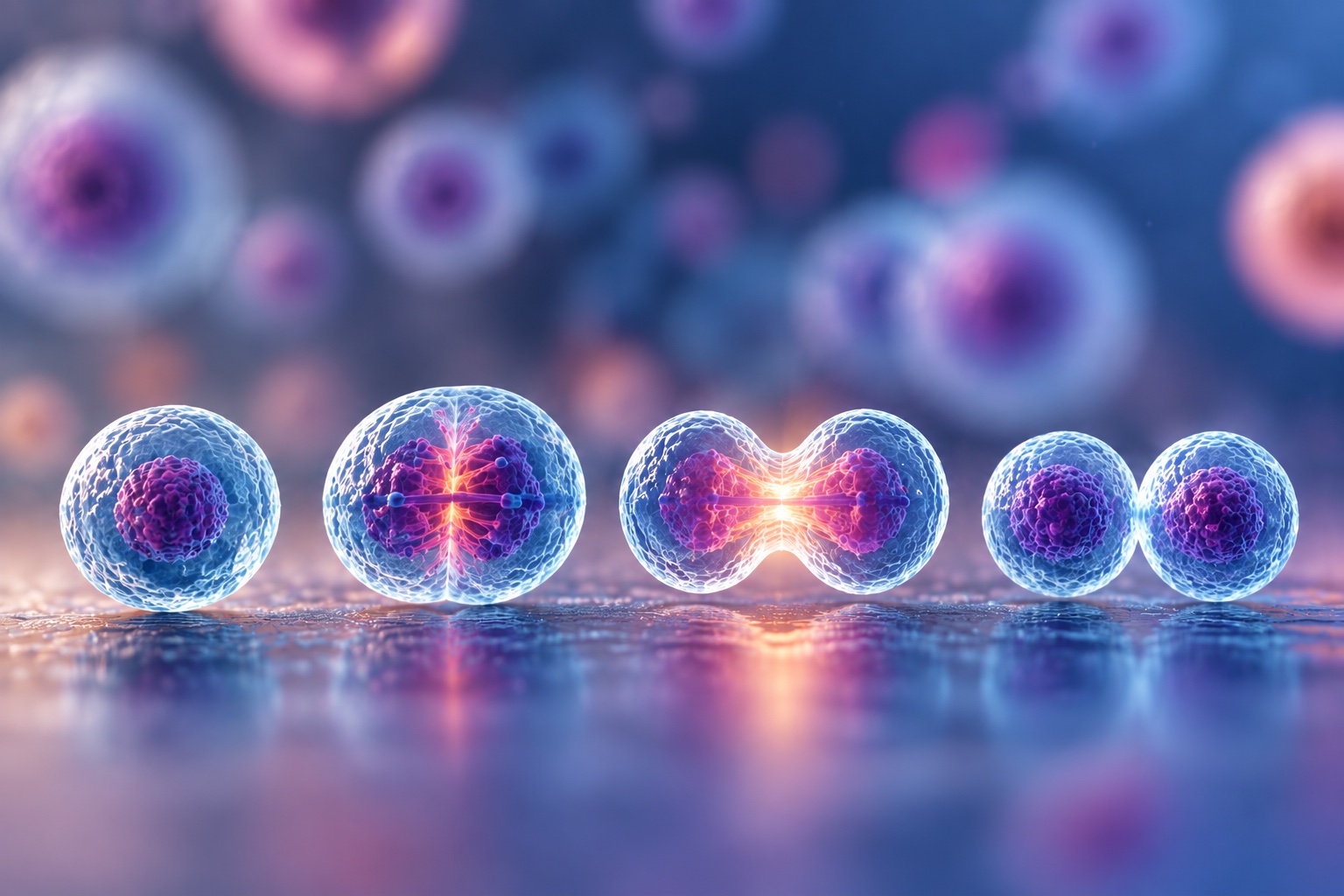
(Illustrative image generated using artificial intelligence.)