
The paper “State-of-the-art in deep learning approaches for automatic single-panorama indoor modeling and exploration” has been published in Computer Graphics Forum. The work is authored by Giovanni Pintore and Enrico Gobbetti (CRS4), in collaboration with colleagues from Hamad Bin Khalifa University (Qatar).
The study provides an in-depth analysis of the most advanced deep learning techniques for reconstructing and exploring indoor environments from a single 360° panoramic image.
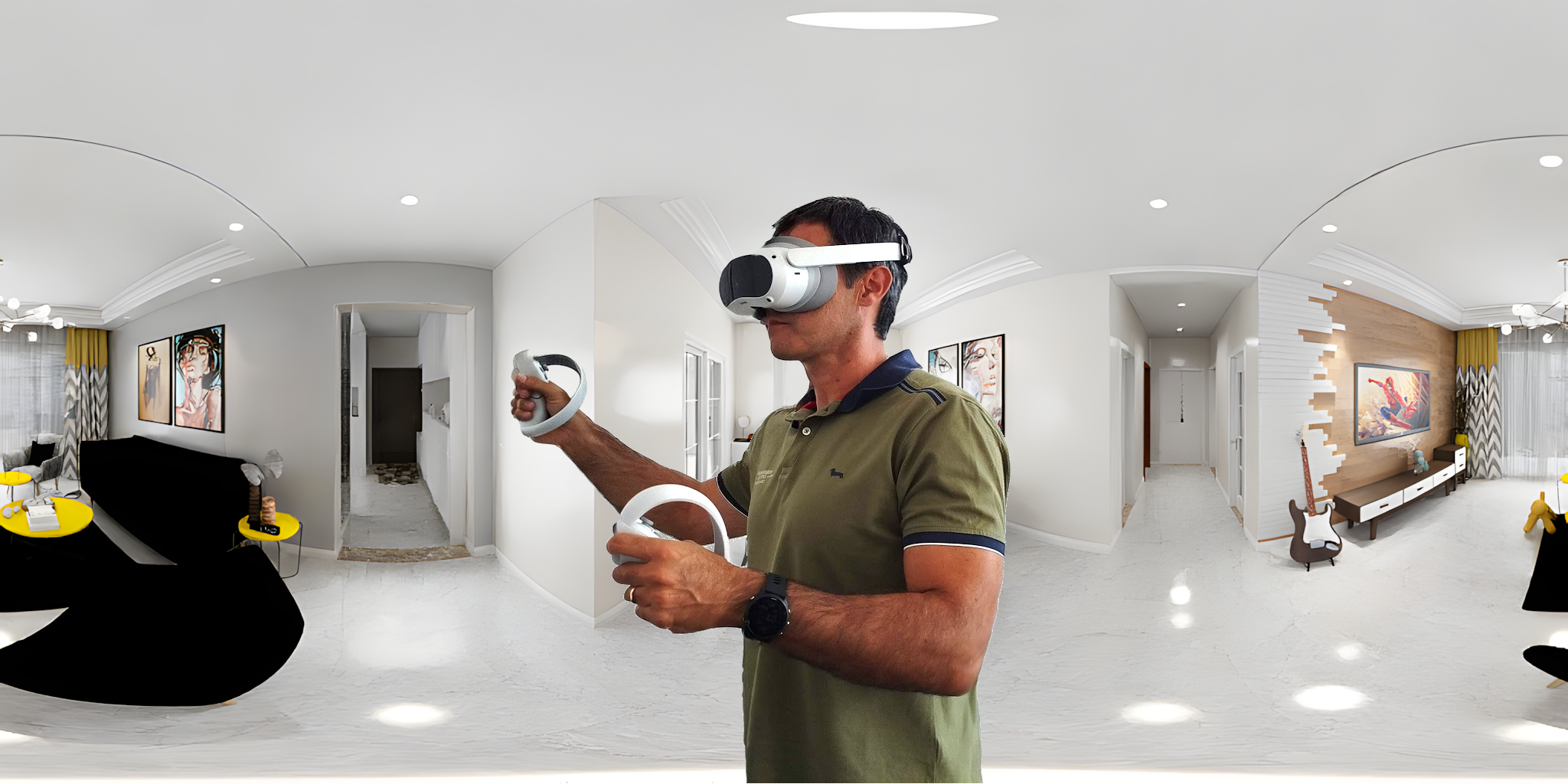
Panoramic images are widely used today to document indoor environments and create virtual tours, as they capture the entire visible space from a single viewpoint. This characteristic makes them effective both for analyzing shape, color, and structure, and for immersive applications, such as virtual reality experiences.
However, panoramic images also present important limitations: they do not contain explicit geometric information, they represent static scenes, and, being captured from a single viewpoint, they suffer from occlusions and lack of parallax. These factors make both scene analysis and realistic 3D exploration challenging without additional processing capable of inferring the missing information.
The work analyzes how recent advances in machine learning, computer vision, and computer graphics address these challenges by inferring complete representations from limited visual data. In particular, it highlights the role of deep learning models, which leverage knowledge learned from large datasets to reconstruct properties that are not directly observable.
The paper describes and analyzes machine learning solutions for the key steps required to transform a single panoramic image into a structured and explorable model, including pixel-level geometric and semantic analysis, indoor layout estimation, and multi-room reconstruction from minimal input data. It also covers novel view synthesis to introduce parallax effects and techniques for immersive exploration of the resulting models.
Beyond reviewing recent methods, the study highlights the emergence of increasingly general approaches, including vision foundation models, as well as techniques specifically designed for panoramic data. It also outlines key open research directions and practical applications of these technologies.
This work is part of the activities of the Visual and Data-intensive Computing sector at CRS4 and reflects a long-standing research line integrating computer vision, computer graphics, machine learning, and advanced visualization techniques.
The study was carried out within the framework of the AIN2 and XDATA projects.
The full bibliographic reference is:
Pintore, G., Agus, M., Schneider, J. and Gobbetti, E. (2026), State-of-the-art in deep learning approaches for automatic single-panorama indoor modeling and exploration. Computer Graphics Forum e70396.
👉 https://doi.org/10.1111/cgf.70396
A public GitHub repository with reference materials and resources for the scientific community is also available:
👉 https://github.com/crs4/panostar