
A study published in Applied Energy proposes a Bayesian and causal machine learning method to estimate heat pump energy consumption from unlabeled smart meter data.
Luca Massidda and Marino Marrocu, researchers at CRS4 within the Visual and Data-intensive Computing (ViDiC) sector, have recently developed a new approach for analyzing residential energy consumption using data from smart meters.
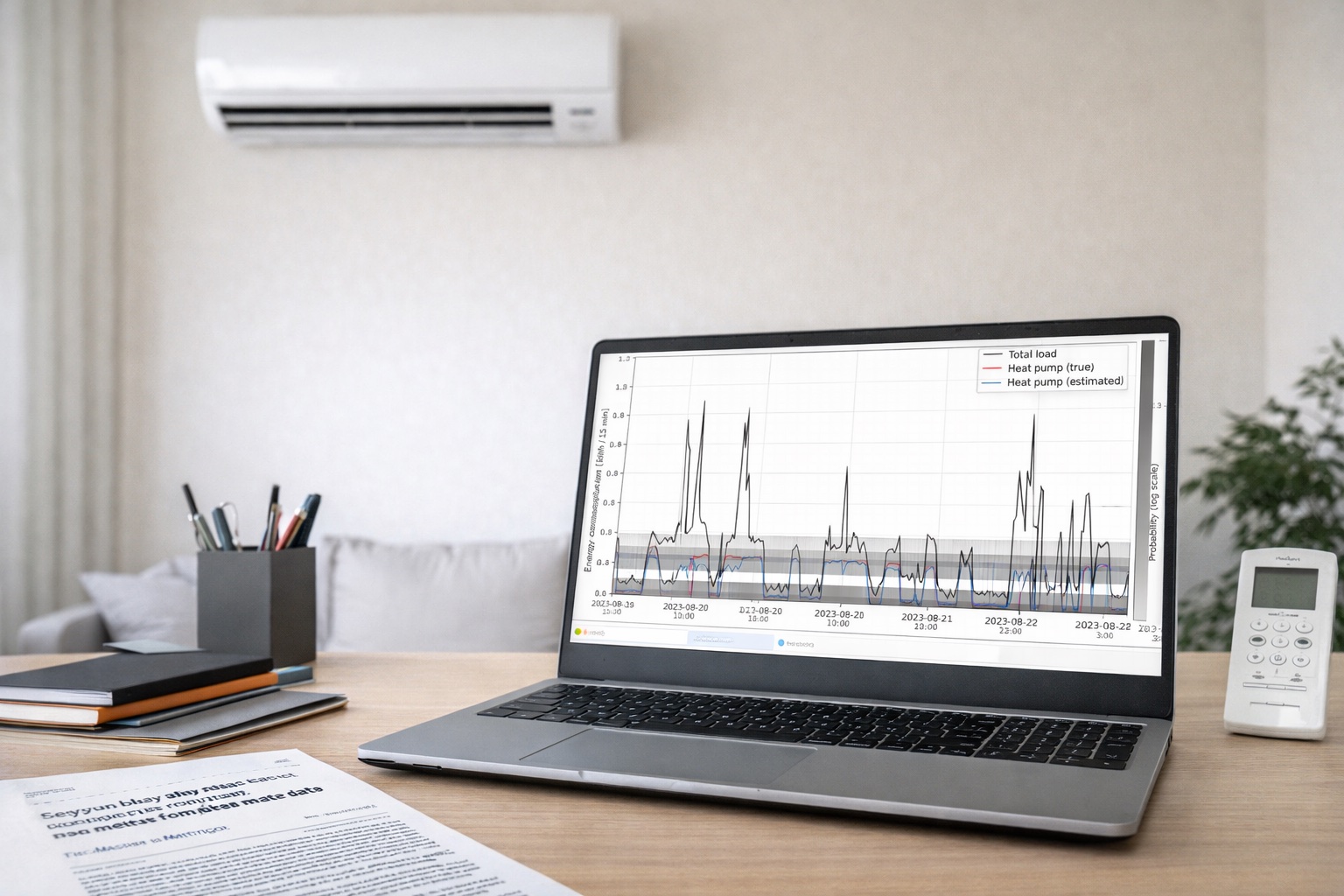
The article, entitled “Beyond labels: Bayesian and causal heat pump disaggregation from unlabeled smart meter data” and published in Applied Energy, introduces a method that makes it possible to estimate the contribution of heat pumps to total electricity consumption without relying on labeled data or dedicated sensors. The approach combines a dual-head deep neural network — trained using transfer learning techniques on data from hundreds of households — with Bayesian probabilistic modeling and causal analysis tools. This innovative combination of machine learning techniques enables the model to address the intrinsic uncertainty of real-world data and to robustly disentangle the different factors influencing energy consumption, such as environmental conditions and user behavior.
From a methodological perspective, the work belongs to the field of load disaggregation (or non-intrusive load monitoring), which aims to break down aggregated building energy consumption into its individual components. The ability to operate on unlabeled data is particularly significant: the models can be directly applied to real-world smart meter data without requiring invasive measurement campaigns or manual labeling of consumption, which is typically needed by traditional supervised machine learning approaches.
This new article is the latest in a series of contributions by the same research group focusing on the analysis of residential building energy consumption using artificial intelligence techniques. A previous study published in Applied Energy introduced a causal machine learning method for forecasting thermal load in residential energy communities, demonstrating the possibility of disaggregating aggregated thermal consumption without direct measurements of individual users. A subsequent work published in Energy and AI showed how thermal load estimates obtained with similar techniques can be directly used to predict demand flexibility and to simulate demand response interventions, paving the way for the operational use of these methods by flexibility aggregators.
This line of research falls within the activities of the Visual and Data-intensive Computing sector at CRS4, which focuses on the analysis and modeling of large-scale complex data, with applications in energy systems and intelligent infrastructures. The availability of reliable tools in this area is particularly relevant in the context of the energy transition, as it can contribute to improving energy efficiency, enhancing grid management, and supporting more effective energy policies.
This work was supported by the PNRR ICSC National Research Centre for High Performance Computing, Big Data and Quantum Computing (CN00000013), under the NRRP MUR programme funded by NextGenerationEU, and by the Autonomous Region of Sardinia through the XDATA project (RAS Art. 9, LR 20/2015).