
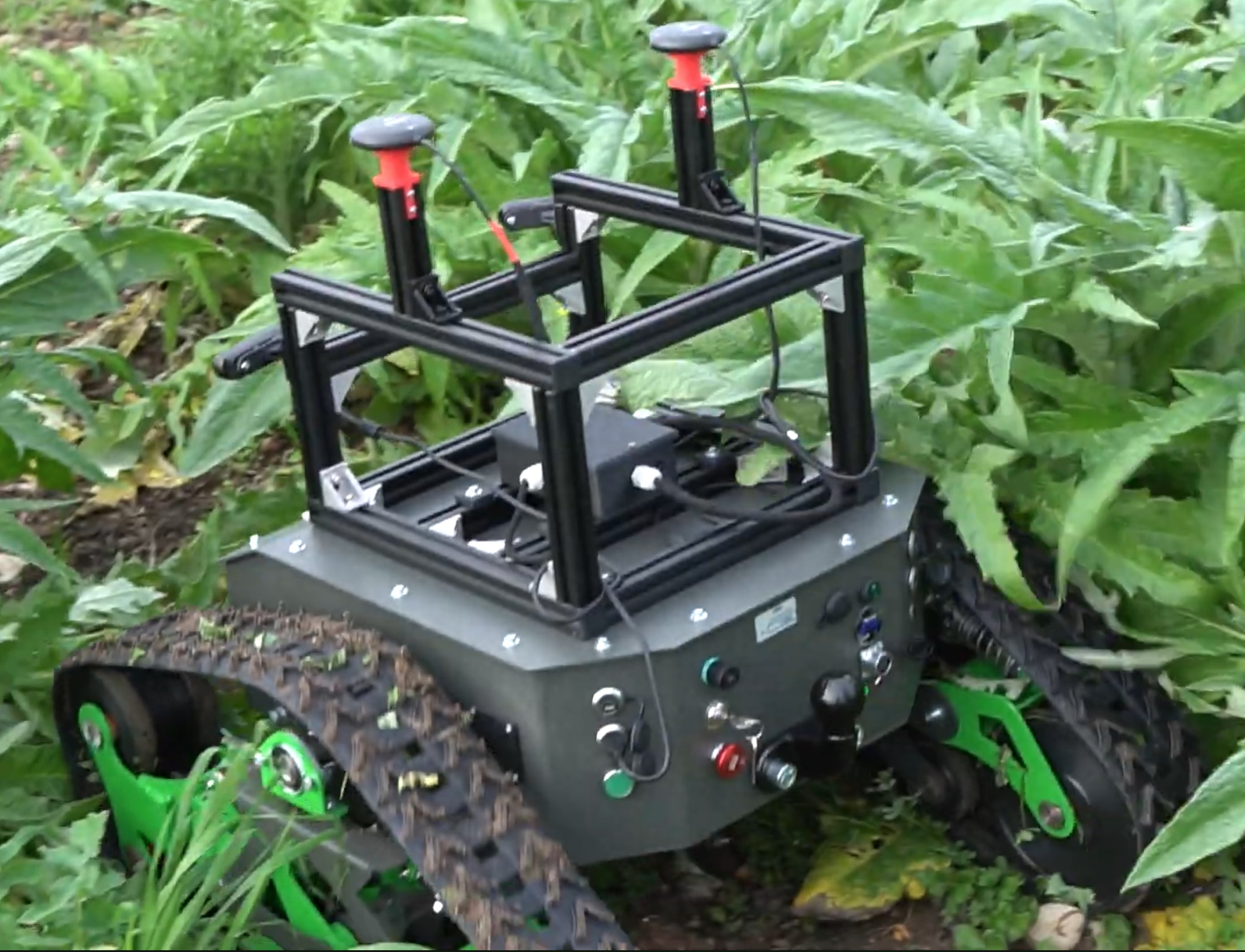
The CRS4 has launched the integration phase of a new tracked robotic platform aimed at developing advanced technologies for the intelligent monitoring of crops. The activity is part of the SMAART project – Sustainability and Management for Precision Agriculture and Livestock Farming through Artificial Intelligence, Robotics and IoT Technologies, an initiative co-funded by the Italian Ministry of Enterprises and Made in Italy (MIMIT).
Last December, a first preliminary field demonstration was carried out in an artichoke crop made available by the project partner University of Sassari, which served as an initial testing environment.
The SMAART project involves Abinsula Srl (project coordinator), the Department of Agricultural Sciences of the University of Sassari, Greenshare Srl, and the producers’ organization Sa Marigosa, which provides agricultural plots for field experimentation. Within the project, CRS4 contributes its expertise in robotics, advanced sensing, computer vision, 3D modelling and artificial intelligence.
The robotic system is based on a commercial outdoor robotic platform, which CRS4 has integrated and adapted to meet research requirements. In particular, the robot has been equipped with an NVIDIA Jetson on-board computer, enabling the execution of artificial intelligence models directly on the platform. This allows real-time environmental perception, sensor data processing and autonomous navigation, even in dense vegetation.
Alongside the computing unit, the system will be equipped with off-the-shelf sensors selected for precision agriculture applications, including depth cameras, stereo cameras, GNSS RTK systems for centimetre-level positioning and inertial sensors. Some devices require dedicated mounts, which are designed and manufactured by CRS4 using 3D printing, allowing rapid reconfiguration of the robot to support different experimental activities.
The core of the research activity focuses on the development of advanced on-board artificial intelligence models. These models will enable the robot to navigate autonomously within cultivated fields, recognising plant structures, fruits and other natural elements, while avoiding damage to valuable vegetation components such as fruits on the ground or parts of the canopy. In parallel, computer vision algorithms will be trained to detect and classify critical crop conditions, including diseases, water or nutrient stress, pest attacks, weeds and biometric anomalies.
The data collected by the robot will be georeferenced and made available to farmers, technicians and researchers, supporting targeted analyses and precision interventions, with the aim of improving sustainability and reducing environmental impact.