
The SpinQ Educational Quantum Computer, recently acquired by CRS4, was the key feature of the public outreach event held on Friday, October 24th at the former Distilleria di Pirri in Cagliari, as part of DLAB | Cagliari Digital Lab, a project promoted by the Municipality of Cagliari to foster the diffusion of emerging technologies across the region.
The initiative was organized by CRS4, in collaboration with QItaly, and offered the audience a unique opportunity to explore the logic and principles of quantum computing, a field that is increasingly central to both scientific and industrial innovation.
Contributions and insights
The event opened with introductory remarks by Giuliana Siddi Moreau (CRS4), who presented the focus of the meeting and the activities launched by the Centre in the field of quantum technologies.
A round table discussion followed, featuring Lidia Leoni (Director of the Quantum and High-Performance Computing, Biosciences and Advanced Studies Division at CRS4), Riccardo Castrignanò (Head of the Innovation and Digital Technologies Service of the Municipality of Cagliari and Cagliari DLAB Coordinator), Antonio Solinas (R&D Director at Abinsula), and Luigi Atzori (Cagliari DLAB Scientific Director and Professor at the University of Cagliari). Together, they discussed the potential impact of quantum technologies on regional growth and innovation.
The outreach session was led by CRS4 researchers and QItaly members:
Lorenzo Pisani, who introduced the physics underpinning nuclear magnetic resonance (NMR)-based quantum computers; Manuela Profir, who illustrated the training and mentoring opportunities offered by QItaly and QWorld international networks; and Maria Laura Clemente, who presented key concepts of quantum programming.
Demonstration of the SpinQ Educational Quantum Computer
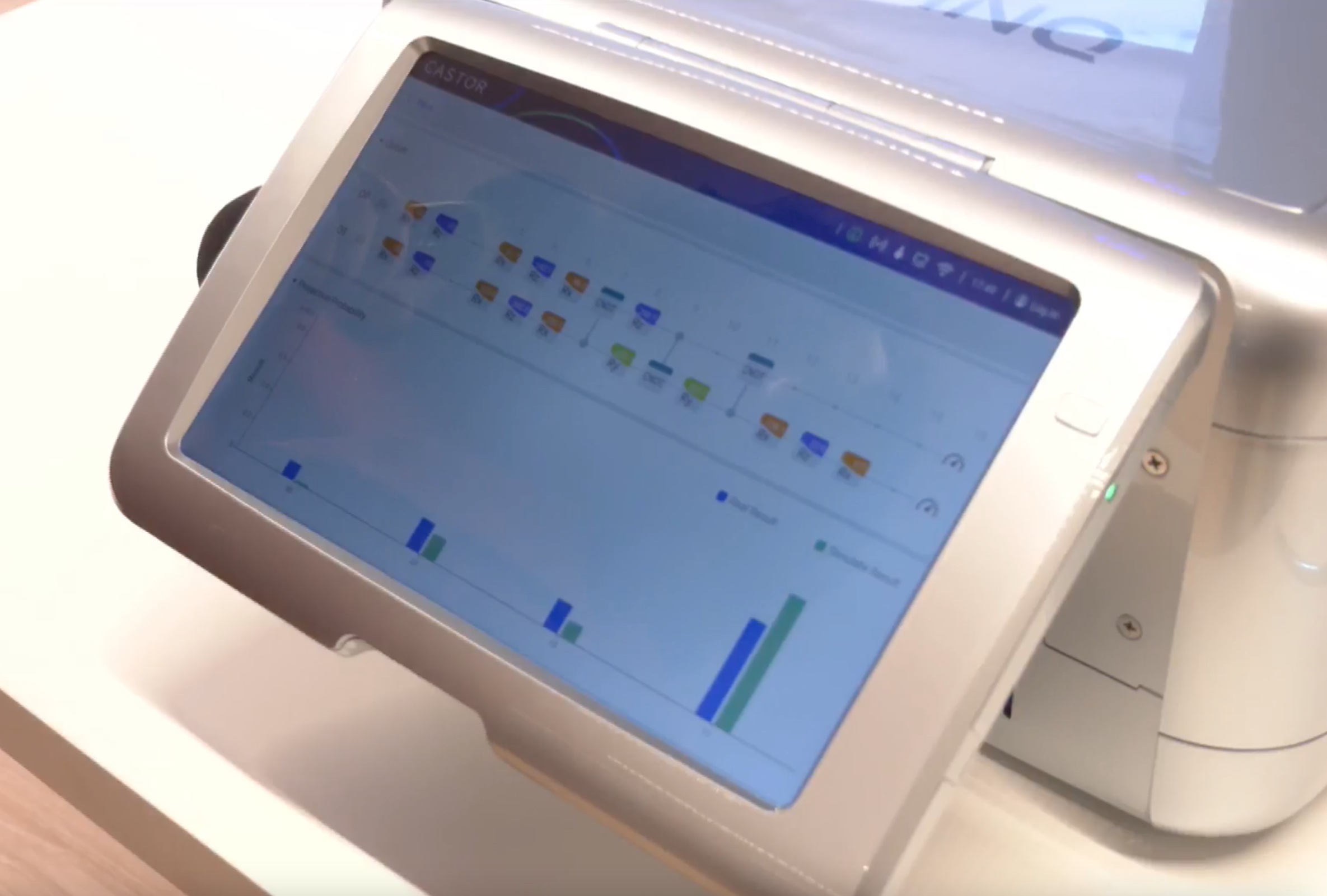
A central moment of the event was the live demonstration of the SpinQ Educational Quantum Computer, a compact platform based on nuclear magnetic resonance (NMR). Thanks to its intuitive interface, the system allows real-time visualization of qubit states and execution of simple quantum algorithms, providing an immediate grasp of the physical phenomena underlying quantum computation.
During the demo, participants had the opportunity to closely observe the system in action and interact directly with the device, experimenting with a selection of pre-configured algorithms designed to explore foundational concepts such as superposition and entanglement.
The strong participation and engagement of the audience highlighted how crucial it is to invest in education and outreach now, preparing students, researchers and professionals to operate in a fast-evolving field. Quantum computing is expected to deliver concrete applications in strategic sectors such as cybersecurity, energy, medicine, finance and smart mobility. Developing the necessary skills today means creating the basis for a competitive and innovation-driven ecosystem capable of embracing future opportunities.
This initiative is part of DLAB | Cagliari Digital Lab, funded by MIMIT – FSC 2014-2020, with the Municipality of Cagliari as coordinator and the following partners: CRS4, Abinsula, Artes 4.0, Cyber 4.0, GreenShare, TIM, University of Cagliari, WiData and WindTre.