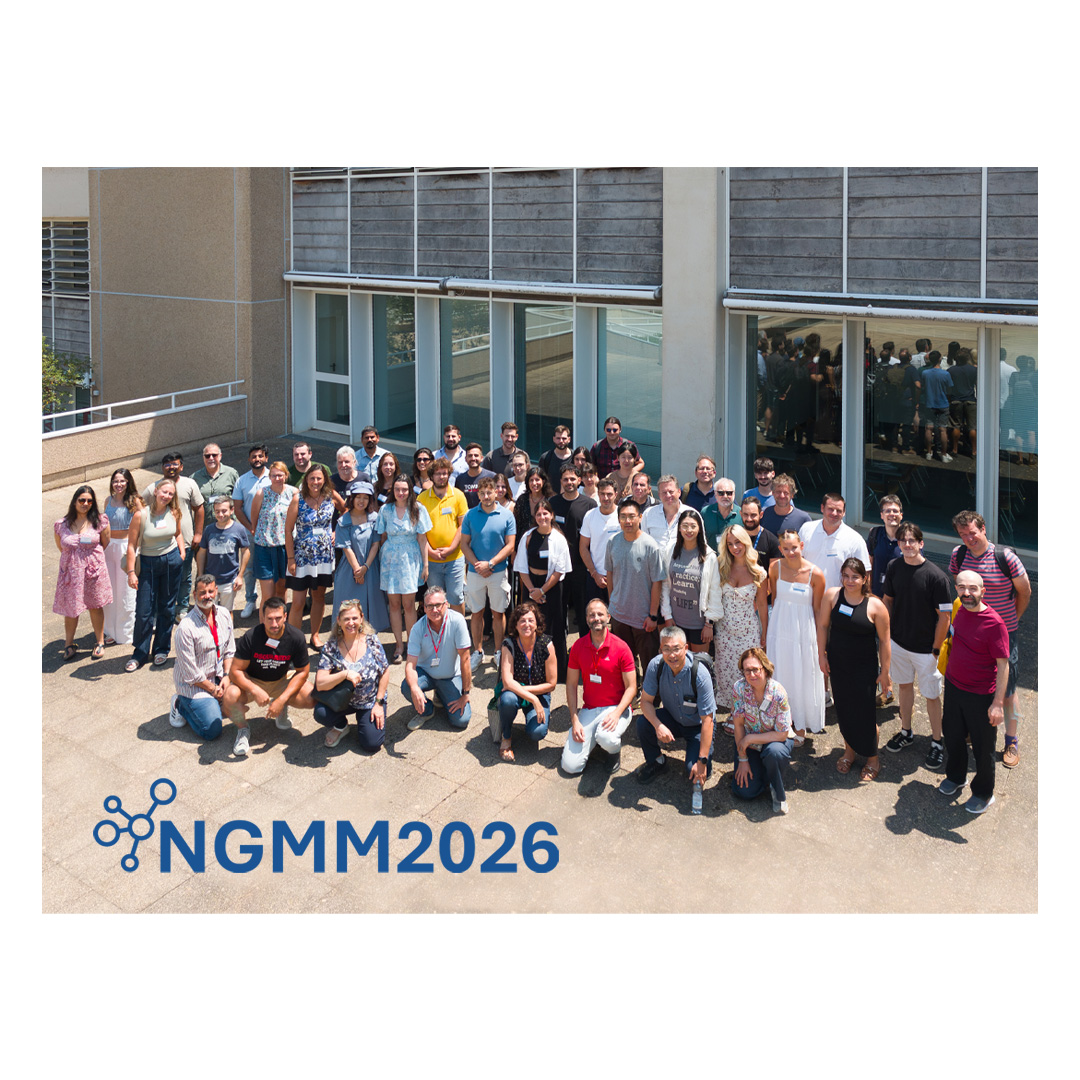

The selection process for participants in NGMM2026 – Next-Generation Molecular Modeling: Bridging Scales with HPC, AI, and Hybrid Methods, the international summer school organized by CRS4 in collaboration with the University of Cagliari, has been completed. The school will take place at the Science and Technology Park of Pula (Sardinia, Italy) from July 27 to 31, 2026.
The school received 104 unique applications from 26 countries, with a strong international component (around 60%) and applicants coming from Europe, Asia, and Africa.
Most applicants are PhD students and early-career researchers working in interdisciplinary fields ranging from computational chemistry and physics to bioinformatics, materials science, and machine learning applications for complex molecular systems.
Following the selection process, 41 participants were admitted from several European and Asian countries. The most represented countries include Italy, Romania, the United Kingdom, Germany, and Spain; participants from Switzerland, Sweden, Belgium, Slovakia, India, and Hong Kong will also attend the school.
The international nature of the school is also reflected in the scientific program, which involves researchers from universities and research centers in several countries, including the University of Vienna, University of Buenos Aires, Queen’s University Belfast, University of Geneva, Jilin University, Stockholm University, University of Genoa, and the University of Cagliari, together with CRS4.
NGMM2026 will provide an advanced overview of state-of-the-art computational approaches for studying complex material and biomolecular systems, from electronic and atomistic descriptions to mesoscale and continuum models.
The school will explore the role of molecular modeling and computational techniques in developing innovative solutions for life sciences and materials design, integrating experimental and simulation data to investigate physicochemical properties, structure–function relationships, reaction mechanisms, and biological dynamics.
Particular attention will be devoted to emerging techniques, including HPC-enabled molecular simulations, enhanced sampling methods, AI and XAI approaches, stochastic modeling, and hybrid and multiscale methodologies for describing and predicting the behavior of materials and biomolecular systems in complex environments.
Further information about the program is available on the dedicated school page: NGMM2026 – CRS4 Summer School
The school is funded by the “Hybrid Hub (H2UB) Project – T4-AN-10, funded under PSC Salute – FSC 2014–2020 – Trajectory 4: Biotechnology, Bioinformatics and Pharmaceutical Development, Italian Ministry of Health.”